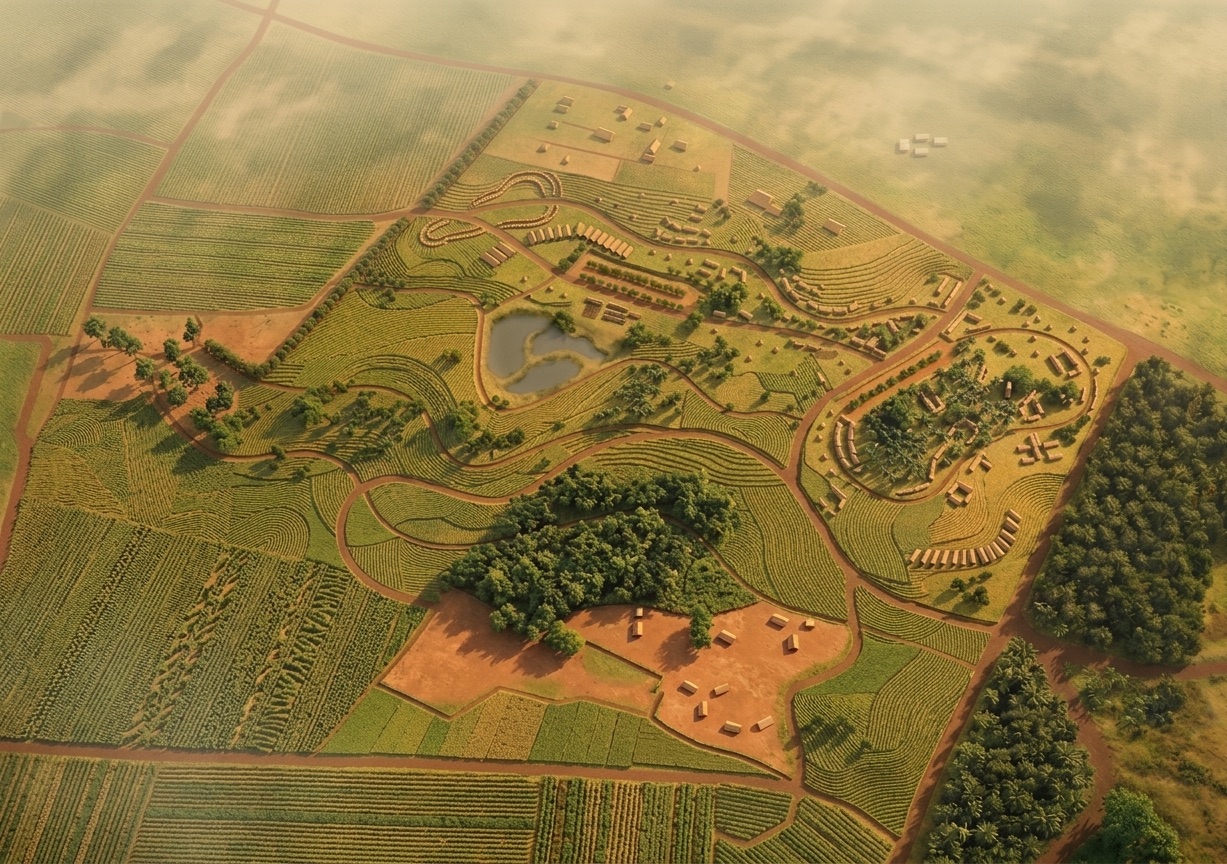
Masterplan render — Revive Farms Phase 1, Bomfa, Ashanti Region, Ghana
Revive Farms is a 44-key agro-hospitality and wellness retreat being developed on a 24-acre site in Bomfa, a small farming community in Ghana's Ashanti Region. The project is the first phase of a larger 73-acre holding that has been in the sponsor's family for generations. Phase 1 converts underutilized farmland into a revenue-generating destination that serves Ghana's growing domestic leisure market at an accessible price point of $22 per person per night — a tier that does not currently exist in the formal hospitality sector.
The business is built on three complementary revenue streams: farm-based lodging across five cabin typologies, a wellness and spa facility, and a working cacao and vegetable farm that supplies the kitchen and anchors the agro-tourism experience. These streams reinforce each other — the farm reduces food cost, the wellness offering drives average spend per guest, and the agro-tourism angle creates differentiation that pure hospitality cannot replicate.
The total development cost is $1.61M, financed through a conservative capital stack: 32% senior bank debt, 13% convertible mezzanine from ThirdWay Capital, and 55% equity from Ghanaian high-net-worth investors at $75,000–$100,000 per LP. At stabilization (Year 3), the project generates $1.15M in revenue and $537K in NOI at a 46.6% GOP margin. Over a 10-year hold, unlevered IRR reaches 21.0% and limited partners see a 4.34× equity multiple at a 23.3% IRR — returns that compare favorably to most institutional real estate benchmarks, at a fraction of the capital required.
The project addresses three overlapping market tailwinds simultaneously: Ghana's domestic middle class seeking nature-based leisure, the sustained government-backed diaspora tourism movement (Year of Return, Beyond the Return, Black Star Experience), and a global surge in demand for experiential and agro-tourism experiences. Revive Farms is designed to serve all three without depending on any one of them.
This page presents the full financial analysis underpinning Phase 1 — market sizing, development cost, operating projections, capital structure, investor returns, and a stress-tested sensitivity analysis across occupancy and currency scenarios.
| Attraction | Annual visitors | Distance |
|---|---|---|
| Kumasi Zoo | 133,954 | 36 mi |
| Manhyia Palace Museum | 106,100 | 36 mi |
| Lake Bosomtwi | 70,000 | 27 mi |
| Bonwire Kente Village | 25,000 | 29 mi |
| Type | Units | Sleeps | USD/Night | USD/Person |
|---|---|---|---|---|
| Studio | 20 | 2 | $60 | $30 |
| 1 Bedroom | 2 | 4 | $85 | $21 |
| 2 Bedroom | 22 | 6 | $115 | $19 |
| Weighted avg | 44 | 4.1 | $89 | $22 |
| Revive | Budget | Mid-range | |
|---|---|---|---|
| Per person/night | $22 | $35 | $98 |
| Family of 4 | $85 | $140 | $390 |
| Group of 6 | $115 | $210 | $585 |
| Rooms needed (6 pax) | 1 | 3 | 3 |
Informal sector flexibility: 80% of Ghana's workforce is self-employed with flexible schedules, enabling midweek travel.
Remote work growth: 69.8% internet penetration. GROW program targeting 250K remote jobs by 2030.
Events & MICE: Ghana's meetings and conference market is growing rapidly, with the country joining ICCA in 2022.
Accessibility: Kumasi is a 30-minute flight from Accra. Bomfa is a 1-hour drive from Kumasi Airport.
Ghana's hospitality market has a structural gap: quality, nature-based accommodation that middle-income earners can actually afford. Existing resorts serve international tourists at $195–$400/night, pricing out the very population that most wants to escape the city. Revive Farms addresses this unmet demand at $22 per person per night, opening a market tier that currently does not exist.
Our primary demand base is Ghana's urban middle class, particularly professionals and families in Accra and Kumasi seeking affordable weekend and midweek getaways. This domestic base is substantial: 61% of all tourism spending in Ghana comes from local travelers, with domestic trips projected to reach 6.6 million by 2025.
This core demand is further bolstered by Ghana's rising prominence as a destination for the global Black diaspora. The Year of Return (2019), Beyond the Return (2020–2030), and the Black Star Experience (2025) have created a sustained, government-backed cultural tourism movement.
Our stabilized occupancy assumption of 58% remains conservative, sitting 10 percentage points below Ghana's 68% projected national hotel average.
| Sources | ||
|---|---|---|
| Senior debt | $513,572 | 31.9% |
| Mezzanine debt | $207,231 | 12.9% |
| LP equity | $800,486 | 49.7% |
| GP / sponsor equity | $88,943 | 5.5% |
| Total sources | $1,610,232 | 100% |
| Uses | ||
|---|---|---|
| Land & acquisition | $176,142 | 10.9% |
| Soft costs | $283,650 | 17.6% |
| Hard costs (cabins) | $545,200 | 33.9% |
| Hard costs (comm. & farm) | $286,400 | 17.8% |
| FF&E + marketing | $81,950 | 5.1% |
| Contingency (20%) | $109,040 | 6.8% |
| Interest reserve + fees | $127,850 | 7.9% |
| Total uses | $1,610,232 | 100% |
The capital stack is structured with conservative leverage at 44.8% debt to 55.2% equity. Senior construction debt is sourced from a Ghanaian bank (ADB or Ecobank), secured by personal guarantees from LP investors. ThirdWay Capital provides mezzanine debt with an option to convert to equity at stabilization. LP equity is raised from Ghanaian high-net-worth individuals at $75,000–$100,000 per investor. The sponsor team co-invests 5.5% alongside LPs.
| Exit cap | 8% | 9% | 10%* | 11% | 12% | 13% | 14% |
|---|---|---|---|---|---|---|---|
| Sale price | $5.29M | $4.71M | $4.23M | $3.85M | $3.53M | $3.26M | $3.02M |
| Unlev. IRR | 22.8% | 21.8% | 21.0% | 20.3% | 19.6% | 19.0% | 18.5% |
| Equity multiple | 4.97× | 4.62× | 4.34× | 4.10× | 3.91× | 3.75× | 3.61× |
| Yr 1 | Yr 2 | Yr 3 | Yr 4 | Yr 5 | Yr 6 | Yr 7 | Yr 8 | |
|---|---|---|---|---|---|---|---|---|
| Phase | Pioneer | Pioneer | Ramp | Ramp | Ramp | Stable | Stable | Stable |
| Occupancy | 34% | 41% | 46% | 52% | 57% | 58% | 58% | 58% |
| ADR | $89 | $93 | $98 | $101 | $104 | $107 | $110 | $113 |
| RevPAR | $31 | $38 | $45 | $52 | $59 | $62 | $64 | $66 |
| Total revenue | $566K | $707K | $834K | $969K | $1,095K | $1,148K | $1,187K | $1,220K |
| GOP | $226K | $300K | $370K | $441K | $508K | $536K | $555K | $572K |
| GOP margin | 40.0% | 42.5% | 44.3% | 45.5% | 46.4% | 46.6% | 46.8% | 46.9% |
| NOI | $122K | $187K | $239K | $301K | $359K | $382K | $397K | $411K |
| NOI margin | 21.5% | 26.5% | 28.7% | 31.0% | 32.7% | 33.2% | 33.5% | 33.6% |
| CDA (4%) | $23K | $28K | $33K | $39K | $44K | $46K | $47K | $49K |
| Tranche | Amount | % | Provider | Terms |
|---|---|---|---|---|
| Senior constr. debt | $514K | 31.9% | Ghanaian bank (ADB/Ecobank) | 8–11%, 24 mo |
| Convertible mezz | $207K | 12.9% | ThirdWay Capital (Accra) | 12–15%, option to convert |
| LP equity | $800K | 49.7% | Ghanaian HNWIs (8–9 investors) | 15% preferred return |
| GP equity | $89K | 5.5% | Sponsor team | Co-invest |
| Total | $1.61M | 100% |
| Parameter | Value |
|---|---|
| Provider | Development Bank Ghana (DBG) / ADB Ghana |
| Loan amount | $873K |
| LTV | 60% |
| Interest rate | 11% |
| Interest-only period | 36 months |
| Amortization | 25 years |
| IRR | EM | Distributions | Invested | |
|---|---|---|---|---|
| Unlevered | 21.0% | 4.34× | — | $1,610K |
| Levered | 24.6% | 5.04× | — | $1,025K |
| Limited partner | 23.3% | 4.52× | $3,243K | $922K |
| Sponsor / GP | 32.6% | 9.80× | $901K | $102K |
| Stabilized occ. | 45% | 50% | 55% | 58%* |
|---|---|---|---|---|
| Unlev. IRR | 17.9% | 19.2% | 20.3% | 21.0% |
| Equity multiple | 3.64× | 3.91× | 4.18× | 4.34× |
| Deprec. | GHS/$ | NOI | DSCR |
|---|---|---|---|
| 0% (base) | 10.8 | $382K | 3.72× |
| 10% | 11.9 | $343K | 3.35× |
| 20% | 13.4 | $305K | 2.97× |
| 30% | 15.4 | $267K | 2.60× |
| 40% | 17.9 | $229K | 2.23× |
| 50% | 21.5 | $191K | 1.86× |
| 60% | 26.9 | $153K | 1.49× |
| 65% | 30.8 | $134K | 1.30× |
| Parameter | Value |
|---|---|
| Leasable farmland | 20 acres |
| Farm infrastructure investment | $100,000 |
| Annual rent per acre | GHS 18,000 ($1,674) |
| Annual escalation | 4% |
| Year 1 net cash flow | $22,716 |
| Year 8 net cash flow | $29,892 |
| 8-year cumulative net | $209,307 (2.1×) |
Local supply chain: On-site farmers supply the tenant restaurants and market vendors, creating a closed-loop food economy.
Cash flow buffer: Farm lease income is contractually fixed and flows regardless of nightly cabin occupancy.
Twenty acres of activated farmland create livelihoods for independent farmers who would otherwise lack access to quality land, irrigation, and processing infrastructure. The farm operator runs a Youth Agro Incubator funded by the 4% Community Development Agreement, training young people to launch agro-businesses across the value chain.
In a region where out-migration is hollowing out farming communities, the farm demonstrates that agriculture and agro-business can be a viable career path, not a last resort.
| Type | Cost / Unit |
|---|---|
| Studio | $3,700 |
| 1 Bedroom | $6,170 |
| 2 Bedroom | $8,640 |
Revive Farms is designed to be replicated. In Bomfa, the anchor is farming. In a coastal village, it could be fishing. In a craft town, weaving. The model is the same: use hospitality as infrastructure to channel urban spending into rural economies, creating jobs, activating land, and giving young people a reason to stay.